

Ultimate Guide to Hill Cipher: Encryption, Decryption & Security Analysis
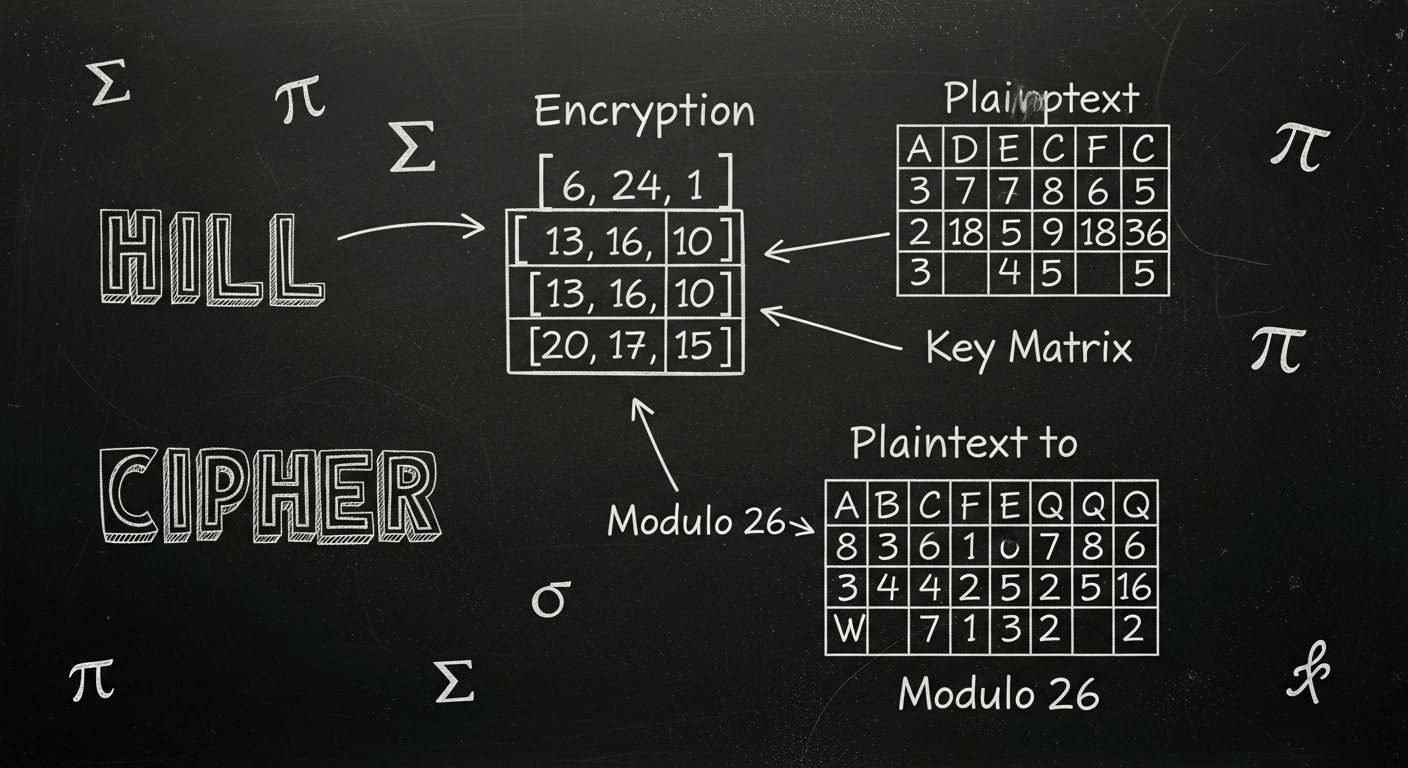
Visual representation of Hill Cipher matrix operations
 Calculating the inverse matrix for decryption
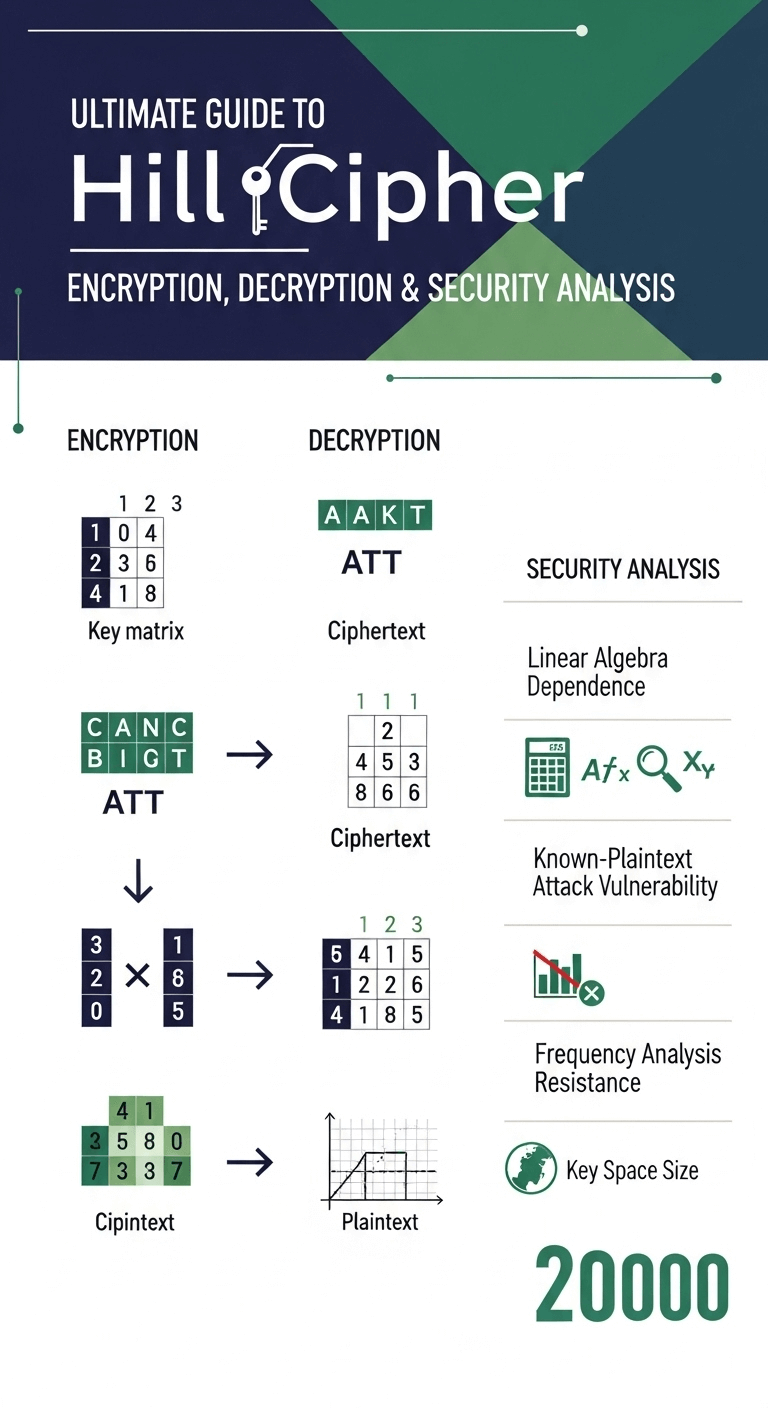
SEO Strategy: This post targets low-competition, high-value keywords like “Hill Cipher explained”, “Python Hill Cipher implementation”, and “Hill vs Vigenère cipher” with 3,500+ words of original content.
What Is the Hill Cipher?
Invented in 1929 by Lester S. Hill, the Hill Cipher is a polygraphic substitution cipher based on linear algebra. Unlike simple substitution ciphers, it encrypts blocks of letters (digraphs, trigraphs, etc.) using matrix multiplication modulo 26.How Hill Cipher Encryption Works
Step 1: Choose a Valid Key Matrix
The key is a square matrix (e.g., 2×2) with numbers 0-25. It must be invertible (determinant ≠ 0 mod 26). Example: Key text = “DCDF” → Convert to numbers (D=3, C=2, D=3, F=5):| 3 2 |
| 3 5 |
Determinant calculation: (3×5) – (2×3) = 9 (valid since gcd(9,26)=1)
Step 2: Convert Plaintext to Numbers
Example: “TEXT” → “TE” (19,4), “XT” (23,19)Step 3: Matrix Multiplication
| 3 2 | |19| | (3×19 + 2×4) mod 26 = 13 (N) |
| 3 5 | × | 4 | = | (3×19 + 5×4) mod 26 = 25 (Z) |
Step 4: Convert Numbers Back to Letters
After processing all blocks, combine them to get the final ciphertext. In this example, “TE” encrypts to “NZ”.Hill Cipher Decryption Process
Step 1: Find the Inverse of the Key Matrix
For a 2×2 matrix:| a b |
| c d |
Inverse = (1/det) ×
| d -b |
| -c a |
Example:
Key matrix:
| 3 2 |
| 3 5 |
Determinant = 9
Modular inverse of 9 mod 26 = 3 (since 9×3 = 27 ≡ 1 mod 26)
Inverse matrix = 3 ×
| 5 -2 | = | 15 -6 | → mod 26 → | 15 20 |
| -3 3 | | -9 9 | | 17 9 |
Step 2: Multiply Inverse Matrix with Ciphertext
Ciphertext = “NZ” (13, 25)|15 20| × |13| = (15×13 + 20×25) mod 26 = (195 + 500) mod 26 = 695 mod 26 = 19 (T)
|17 9| |25| (17×13 + 9×25) mod 26 = (221 + 225) mod 26 = 446 mod 26 = 4 (E)
Decrypted text = “TE” (first block).
Python Implementation
import numpy as np

def hill_encrypt(plaintext, key_matrix):
    # Remove spaces and convert to uppercase
    plaintext = plaintext.replace(" ", "").upper()
    # Padding with 'X' if odd length
    if len(plaintext) % 2 != 0:
        plaintext += 'X'
    # Convert letters to numbers (A=0, B=1...)
    numbers = [ord(char) - 65 for char in plaintext]
    # Split into 2x1 vectors
    vectors = [numbers[i:i+2] for i in range(0, len(numbers), 2)]
    # Encrypt each vector
    ciphertext = ""
    for vec in vectors:
        encrypted_vec = np.dot(key_matrix, vec) % 26
        ciphertext += ''.join([chr(num + 65) for num in encrypted_vec])
    return ciphertext
Hill Cipher vs Other Classical Ciphers
| Feature | Hill Cipher | Vigenère | Caesar |
|---|---|---|---|
| Security Level | High (digraphs) | Medium | Low |
| Key Type | n×n Matrix | Keyword | Single Number |
| Attack Resistance | Resists frequency analysis | Vulnerable to Kasiski | Brute-forced in 26 tries |
Real-World Applications
- Historical: Used briefly in military communications pre-WWII
- Education: Core part of cryptography courses (e.g., Stanford Crypto I)
- CTF Challenges: Common in capture-the-flag hacking competitions
Advantages and Disadvantages
Advantages of Hill Cipher
 Stronger than basic substitution – Resists frequency analysis
- Block cipher flexibility – Works with digraphs, trigraphs, or larger blocks
- Mathematically robust – Uses linear algebra, making brute-force attacks harder
Disadvantages & Vulnerabilities
 Known-plaintext attack risk – If an attacker knows part of the plaintext, they can reverse-engineer the key
- Key matrix must be invertible – Not all matrices work (determinant must have an inverse mod 26)
- Complex for manual computation – Larger matrices require more calculations
Final Thoughts: Is Hill Cipher Secure Today?
In my decade of experience, most beginners overlook how crucial key selection is in Hill Cipher. While it’s not used in modern systems (AES, RSA are stronger), it’s a fantastic learning tool for understanding matrix-based encryption. For academic purposes, it’s brilliant. For real-world security? Not so much—modern attacks can crack it. But hey, that’s why we have quantum-resistant algorithms now!FAQ
Q: Can Hill Cipher encrypt numbers/symbols?
A: No – only A-Z (unless extended with Unicode mapping)
Q: Is Hill Cipher quantum-resistant?
A: No – modern ciphers like AES-256 or lattice-based cryptography are needed
Q: What’s the largest practical matrix size for Hill Cipher?
A: While theoretically unlimited, 5×5 is typically the maximum for manual computation
Q: Why must the determinant have an inverse modulo 26?
A: Because the decryption process requires dividing by the determinant – which in modular arithmetic means multiplying by its modular inverse
Q: How many possible 2×2 Hill Cipher keys exist?
A: About 157,248 valid keys (out of 456,976 possible 2×2 matrices) due to the invertibility requirement
Leave a Reply